
Episode Summary
David Bain explains why traditional marketing funnels waste advocacy, and introduces the Pump and Funnel model and 6H content framework to turn customers into a continuous source of new demand.
Key Takeaways
- 1Traditional marketing funnels end at advocacy, wasting your single best source of new demand: happy customers who recommend you.
- 2The Pump and Funnel model curves the funnel into a loop by adding the Lake of Loyalty (a reservoir of happy customers) and the pump (which pushes advocacy back to awareness).
- 3The 6H content framework extends Google’s hero-hub-help model by adding heart (conversion pages), happy (onboarding), and human (one-to-one advocacy touchpoints) to cover the entire customer journey.
- 4Audit your content first, build the missing pieces second, and only then switch on traffic: driving people to unready content wastes resources.
- 5Channels change, but people don’t. When a new platform appears, simply ask which content type it should feed, and the model outlives every trend.
Contents
- Introduction
- What Is the Pump and Funnel Marketing Model?
- Why Does a Marketing Funnel Need to Become a Loop?
- What Moves People Through the Funnel?
- What Is the 6H Content Marketing Framework?
- What Is Hero Content, and How Often Should You Publish It?
- What Is Help Content, and Why Does It Matter for AI Search?
- What Is Hub Content, and Where Does It Sit?
- What Is Heart Content, and How Do You Structure a Sales Page?
- What Is Happy Content, and Why Is Onboarding Overlooked?
- What Is Human Content, and How Does It Drive Advocacy?
- How Much Content Do You Actually Need?
- Which Marketing Channels Pair With Which Content Types?
- What’s the 90-Day Plan to Implement the Model?
- Why You Should Never Chase Traffic Before Content Is Ready
Introduction
Your marketing is busy, really busy.
Campaigns launch, blog posts go out, the podcast records, the ads are running, the newsletter sends on time. And yet something feels off.
The blog has nothing to do with the paid social. The podcast sits in its own little corner. Nobody can quite draw the line from one piece of content to the next. It all feels disconnected.
Introducing the Pump and Funnel
If that sounds like your marketing, the Pump and Funnel Marketing Model offers a way to pull every disparate activity into one unified, self-perpetuating loop.
By the end of this article, you’ll understand the circular customer acquisition path, the funnel, the Lake of Loyalty, the pump, the six types of content that bring it to life, and a simple 90-day plan to put it to work.
What Is the Pump and Funnel Marketing Model?
Start with something you already know: the marketing funnel. Awareness, consideration, conversion, loyalty, advocacy.
It’s a neat way to picture where a customer sits on the path to buying. It’s useful, but it has a flaw. It’s a straight line and it ends at advocacy.
It quietly tells you the job is done the moment a customer is happy, and says nothing about what that happy customer could do next. That’s a problem, because a happy customer is your single best source of new demand.
The traditional funnel just lets them walk off the end. The Pump and Funnel model curves it into a loop.
How the model differs from a traditional marketing funnel
“The Pump and Funnel model retains the 5 stages in the existing funnel. It just rearranges them and adds 2 additional key elements. Firstly, the Lake of Loyalty. Picture a reservoir at the bottom of the funnel. Instead of customers dropping off the end, they collect in a pool.”— DAVID BAIN, HOST, THE PUMP AND FUNNEL MARKETING SHOW
Picture a reservoir at the bottom of the funnel. Instead of customers dropping off the end, they collect in a pool: happy, loyal customers building up over time. They’re not a closed transaction. They’re an asset.
Secondly, the pump. The pump drives advocacy from the Lake of Loyalty and pushes eyeballs towards the top of the funnel, back into fresh awareness.
Why Does a Marketing Funnel Need to Become a Loop?
You already know this from experience. A happy customer recommends you to a friend.
That’s new demand, and it costs your business almost nothing. The pump is that advocacy force made deliberate.
The funnel moves people down towards a sale. The pump pushes advocacy back up to create new demand. Together, a loop, not a one-way funnel.
How the loop structure brings sales and service into marketing
“And there’s a quiet benefit here too. Loyalty and advocacy aren’t owned by marketing alone. They’re shaped every day by sales and customer service. Draw this acquisition process as a loop, and suddenly those…teams are part of marketing.”— DAVID BAIN, HOST, THE PUMP AND FUNNEL MARKETING SHOW
What Moves People Through the Funnel?
The funnel shows the stages a customer moves through, but it doesn’t say what moves them. People don’t drift from awareness to advocacy on their own.
They need something to engage with at every step. They need content: relevant, high-quality content. That’s where the 6H content framework comes in.
What Is the 6H Content Marketing Framework?
The framework starts with a great one: Google and YouTube‘s 3H model, hero-hub-help. This hero, hub and help content maps beautifully onto the top of the funnel.
Hero content maps to awareness, help content maps to consideration, and hub content sits outside the funnel. But the original 3H model was designed to attract people, not convert them.
So the 6H framework extends it by adding three more content types: heart, human and happy.
6H Content Types at a Glance
| Content Type | Funnel Stage | Purpose | Example |
|---|---|---|---|
| Hero | Awareness | Big spectacular moment, shareable on its own | Book, research report, virtual summit |
| Help | Consideration | Answers real search questions | Blog posts, FAQs, how-to guides |
| Hub | Outside/alongside funnel | Keeps brand top of mind when prospects aren’t ready to buy | Podcast, YouTube series, episodic content |
| Heart | Conversion | Sales pages structured why-how-what | Landing pages, product pages |
| Happy | Loyalty | Post-purchase experience, kills buyer’s remorse | Welcome sequences, onboarding videos, getting-started content |
| Human | Advocacy | One-to-one connection, turns customers into fans | Case study requests, personal thank-you videos |
Six types of content. Every stage of the customer journey covered.
What Is Hero Content, and How Often Should You Publish It?
Hero content is your big spectacular piece: a book, a research report, a virtual summit, so good that people share it on their own.
You don’t make hero content often, maybe once a year. Hero content is about higher quality and less frequent publishing.
What Is Help Content, and Why Does It Matter for AI Search?
Help content answers real questions, the real questions your audience is searching for, and it’s often served by a blog post.
Go after the long-tail questions, four or five keywords long. Lower volume, sure, but easier to rank for and far more relevant. 100 pages getting 10 visits each beats one page getting 1,000, because that one high-traffic page can vanish in a single algorithm update.
Help content is also precisely what AI search engines are looking for.
What Is Hub Content, and Where Does It Sit?
Hub content sits outside the funnel, but alongside the funnel. It’s the content your prospects consume to educate them more about your industry or your service when they’re not quite ready to buy.
They’re not actively in your funnel at present. This is your opportunity to keep your brand top of mind until they’re ready to buy and hop back into your funnel.
If you don’t see the value of hub content because it’s not directly inside your funnel, the chances are that your competitors will.
Hub content tends to be regular episodic content: a podcast, a YouTube series.
What Is Heart Content, and How Do You Structure a Sales Page?
Heart content maps to the conversion stage. Your sales pages and landing pages where the sale is won or lost when the customer is on your website.
Why emotional messaging should come before feature descriptions
“Like Simon Sinek’s book Start With Why, structure these landing pages: why, how, what. Lead with an emotional why, then a short specific how, and…only after that, a description of what the business or product does.”— DAVID BAIN, HOST, THE PUMP AND FUNNEL MARKETING SHOW
The accounting software Xero does this really well. Their headline isn’t “Send invoices and run payroll.” It’s “Xero makes small business accounting easy.” That’s the why.
After the why, and only when the user is intrigued by the why, do they scroll down and discover the how: automate everyday business tasks.
Then, and only then, do you find out exactly what service Xero provides: the what. Everything you need to run your business. Check out how many top websites mimic this structure. You’ll be surprised.
What Is Happy Content, and Why Is Onboarding Overlooked?
Happy content is everything a new customer experiences right after they buy: the welcome, the onboarding, the getting-started videos. It’s wildly overlooked, certainly by marketers, and it’s one of the key relationship-building moments. Get it right and you kill buyer’s remorse before it starts.
What Is Human Content, and How Does It Drive Advocacy?
Human content is what turns a loyal customer into a genuine fan. A request for a case study conversation, a short personal thank-you video, real one-to-one human connection. It takes minutes and it’s what drives people up the pump.
How Much Content Do You Actually Need?
Before you get started, audit what you’ve already got. List every piece of useful content you have at the moment. Drop each one into its appropriate H: hero, help, hub, heart, happy, human. Straight away, you’ll see the gaps.
Here’s a sensible target: one strong hero piece, around 12 pieces of help content, a 12-episode hub series, one key heart page rebuilt to convert with a why-how-what flow in mind, one happy onboarding sequence, and one repeatable human touchpoint.
Then run the GAP checklist, reviewing honestly what you’re currently missing.
Only now do we talk about traffic. It’s tempting to chase eyeballs and explore new tactics early. Don’t. There’s no point in sending traffic to content that isn’t ready.
Which Marketing Channels Pair With Which Content Types?
Once your content’s ready, you can then explore marketing channels.
Channels Matched to Each Content Type
| Content Type | Recommended Channel | Purpose |
|---|---|---|
| Hero | Partnerships with external industry influencers | Amplify big moments |
| Hub | Social ads | Post clips from episodes and pay to promote the best ones |
| Help | Organic search and AI search | Answers real questions, so it ranks |
| Heart | Retargeting and paid search | Re-engage warm prospects who looked but didn’t buy |
Stop thinking about driving traffic. Start thinking about driving the right person to the right piece of content at the right time.
Channels change. People don’t. When a new channel appears, you just ask the question: which H should this channel feed? The model outlives every platform.
What’s the 90-Day Plan to Implement the Model?
One quarter. Three months.
90-Day Implementation Plan
| Month | Focus | Tasks |
|---|---|---|
| Month 1 | Audit and fill the gaps | Map content to the 6Hs; run the GAP checklist; pick your hub vehicle; rebuild your most important heart page; plan your hero piece |
| Month 2 | Build the engine | Record your first hub episodes; write your first help pages fed by your hub episodes; create a simple happy onboarding sequence; start one human content habit |
| Month 3 | Connect and prime the pump | Match a channel to each H; launch your clips; switch the pump on with referrals, case studies, testimonials; happy customers start creating new awareness |
Why You Should Never Chase Traffic Before Content Is Ready
Notice the order: audit, build, then traffic. This is a mistake many marketers have made, and it wastes resources. Driving people to unready content means those visits don’t convert, those prospects don’t return, and the traffic budget delivers nothing. Build the engine first. Then switch it on.
That’s the model: a funnel that loops, a lake that fills, a pump that turns happy customers into new demand, and six types of content that moves prospects every step of the way.
Read the Full Episode Transcript
[00:00] David Bain: Your marketing is busy, really busy. Campaigns launch, blog posts go out, the podcast records, the ads are running, the newsletter sends on time, and yet something feels off. The blog has nothing to do with the paid social. The podcast sits in its own little corner. Nobody can quite draw the line from one piece of content to the next. It all feels disconnected.
If that sounds like your marketing, stay with me. The Pump and Funnel Marketing Show with David Bain.
It’s David. Way back in 2007, I delivered my first ever digital marketing training session. And ever since then, I’ve been on a journey to help professional marketers pull together every disparate marketing activity into one unified model, the Pump and Funnel Marketing Model.
[00:48] Welcome to episode 1 of the Pump and Funnel marketing show. By the end of this, you’ll have a broad understanding of the whole Pump and Funnel marketing model, including how everything ties together, the circular customer acquisition path, the funnel, the Lake of Loyalty, the pump, the 6 types of content that bring it to life, and a simple plan to put it to work.
[01:13] Let’s get on to it. Let’s start with something you already know. The marketing funnel. Awareness, consideration, conversion, loyalty, advocacy. It’s a neat way to picture where a customer sits on the path to buying. It’s useful, but it has a flaw. It’s a straight line and it ends at advocacy.
[01:39] So it quietly tells you the job is done the moment a customer is happy. It says nothing about what that happy customer could do next. And that’s a problem because a happy customer is your single best source of new demand.
[01:54] The traditional funnel just lets them walk off the end. So I curved the funnel. I turned that straight line into a self-perpetuating loop. The Pump and Funnel model retains the 5 stages in the existing funnel. It just rearranges them and adds 2 additional key elements.
[02:14] Firstly, the Lake of Loyalty. Picture a reservoir at the bottom of the funnel. Instead of customers dropping off the end, they collect in a pool. Happy, loyal customers building up over time. They’re not a closed transaction. They’re an asset.
[02:32] Secondly, the pump. The pump drives advocacy from the Lake of Loyalty and pushes eyeballs towards the top of the funnel, back into fresh awareness. You already know this. A happy customer recommends you to a friend. That’s new demand, and it costs your business almost nothing.
[02:58] The pump is that advocacy force made deliberate. The funnel moves people down towards a sale. The pump pushes advocacy back up to create new demand. Together, a loop, not a one-way funnel.
[03:09] And there’s a quiet benefit here too. Loyalty and advocacy aren’t owned by marketing alone. They’re shaped every day by sales and customer service. Draw this acquisition process as a loop, and suddenly those sales and customer service teams are part of marketing. The Pump and Funnel marketing model invites them in.
[03:35] Now here’s another key element. The funnel shows the stages a customer moves through, but it doesn’t say what moves them. People don’t drift from awareness to advocacy on their own. They need something to engage with at every step. They need content. Relevant, high-quality content.
[03:52] So I needed a content framework, and I started with a great one. Google and YouTube’s 3H model that I’m sure you’re aware of already: hero, hub, and help. This hero, hub, and help content maps beautifully onto the top of the funnel.
[04:09] Hero content maps to awareness, help content maps to consideration, and hub content actually sits outside the funnel. More about that in a second. Firstly, let’s look at examples of each type of content, each H. Hero content or awareness. This is your big spectacular piece, a book, a research report, a virtual summit, so good that people share it on their own.
[04:46] You don’t make hero content often, maybe once a year. Hero content is about higher quality and less frequent publishing. Next, help content for consideration. Help content answers real questions, the real questions your audience is searching for, and it’s often served by a blog post.
[05:08] Go after the long-tail questions, 4 or 5 keywords long if you want to call it that. Lower volume, sure, but easier to rank for and far more relevant. 100 pages getting 10 visits each beats 1 page getting 1,000 because that one high-traffic page can vanish in a single algorithm update.
[05:34] Help content is also precisely what AI search engines are looking for. More about that in future episodes. Thirdly, hub content outside the funnel, but alongside the funnel. Alongside, because this is the content that your prospects consume to educate them more about your industry or your service when they’re not quite ready to buy.
[05:54] They’re not actively in your funnel at present. This is your opportunity to keep your brand top of mind until they’re ready to buy and hop back into your funnel. And if you don’t see the value of hub content because it’s not directly inside your funnel, the chances are that your competitors will.
[06:14] Hub content tends to be regular episodic content. A podcast, a YouTube series, like this one. However, you may have noticed that only the top part of the Pump and Funnel marketing model has content that’s mapped to it.
[06:32] This is because hero, hub, and help content is designed to attract people, not convert people. We need some more H’s. Enter the 6H content marketing framework, including heart, human, and happy content.
[06:55] So let’s find out more about those additional H’s. Heart content maps to the conversion stage, happy content to loyalty, and human content to advocacy. So let’s find out more about the new 3 H’s. Heart content for conversion. Your sales pages and landing pages where the sale is won or lost when, of course, the customer is on your website.
[07:25] Like Simon Sinek’s book Start With Why, structure these landing pages: why, how, what. Lead with an emotional why, then a short specific how, and after that, and only after that, a description of what the business or product does.
[07:48] The accounting software Xero do this really, really well. Their headline isn’t “Send invoices and run payroll.” It’s “Xero makes small business accounting easy.” That’s the why. After the why, and only when the user is intrigued by the why, do they scroll down and discover the how? Automate everyday business tasks.
[08:20] Then, and only then, do you find out exactly what service Xero provides, the what? Everything you need to run your business. Check out how many top websites mimic this structure, the why, how, what flow on their top conversion pages. You’ll be surprised.
[08:42] Next, it’s happy content for loyalty. This is everything a new customer experiences right after they buy. The welcome, the onboarding, the getting started videos. It’s wildly overlooked, certainly by marketers, and it’s one of the key relationship building moments. Get it right and you kill buyer’s remorse before it starts.
[09:00] And finally, human content for advocacy. This is what turns a loyal customer into a genuine fan. A request for a case study conversation, a short personal thank you video, real one-to-one human connection. It takes minutes and it’s what drives people up the pump.
[09:20] 6 types of content, 6 H’s. Every stage of your customer journey covered. So how much of each type of content do you actually need? Before you get started, audit what you’ve already got. List every piece of useful content you have at the moment. Drop each one into its appropriate H. Hero, help, hub. Heart, happy, human.
[09:46] Straight away, you’ll see the gaps. Here’s a sensible target: one strong hero piece, around 12 pieces of help content, a 12-episode hub series, one key heart page rebuilt, of course, to convert with a why, how, what flow in mind, one happy onboarding sequence, and one repeatable human touchpoint.
[10:09] Then run the GAP checklist. Review honestly what you’re currently missing out on. Only now do we talk about traffic. It’s tempting to chase eyeballs and explore new tactics early. Don’t. There’s no point in sending traffic to content that isn’t ready.
[10:31] Once your content’s ready, you can then explore marketing channels. Hero pairs with partnerships. Partnerships with external industry influencers. Hub pairs with social ads. Post clips from your episodes onto appropriate social platforms and pay to promote the best ones.
[10:52] Help pairs with organic search. It answers real questions, so it ranks, and it’s exactly what AI search pulls from too. And heart pairs with retargeting and paid search. Reengage the warm prospects who looked but didn’t buy.
[11:09] Stop thinking about driving traffic. Start thinking about driving the right person to the right piece of content at the right time. And here’s the last thing. Channels change. People don’t. When a new channel appears, you just ask the question, which H should this channel feed. The model outlives every platform.
[11:41] Let me leave you with a plan. One quarter, three months. Month one: audit and fill the gaps. Map your content to the 6 H’s. Run the checklist. Pick your hub vehicle. Rebuild your most important heart page. Plan your hero piece.
[12:04] Month 2: Build the engine. Record your first hub episodes. Write your first help pages fed by your hub episodes. More about that in episode 3. Create a simple, happy onboarding sequence and start one human content habit, even just a personally recorded welcome video to target customers.
[12:26] Moving on to month 3, connect and prime the pump. Match a channel to each H. Launch your clips and switch the pump on. Referrals, case studies, testimonials. This means that your happy customers start creating new awareness on your behalf.
[12:47] Notice the order: audit, build, then traffic. Please don’t do what I’ve done in the past and what many of you, I’m sure, have done in the past too. Don’t make the mistake of chasing traffic before the content is ready.
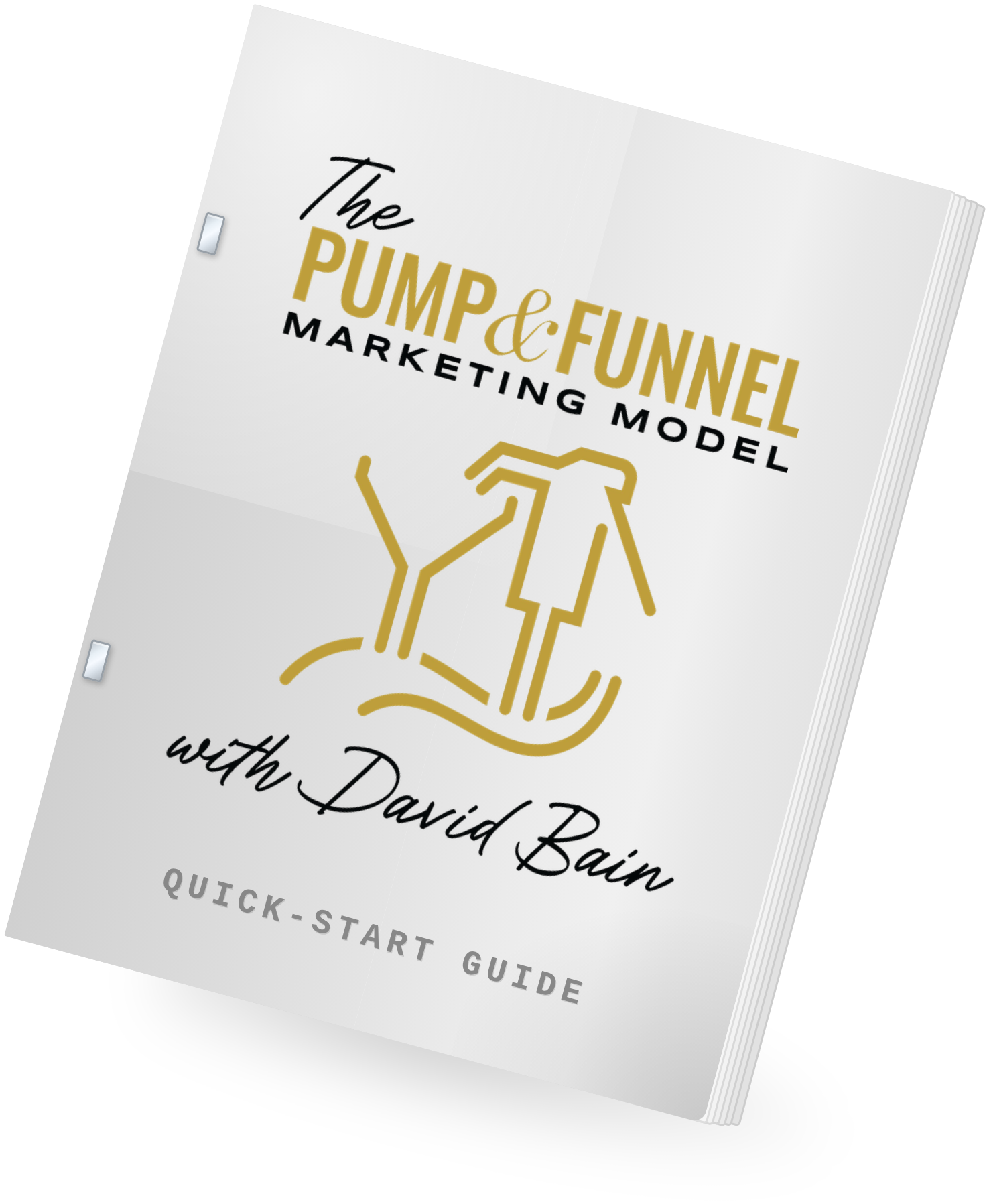
[13:04] So that’s the model: a funnel that loops, a lake that fills, a pump that turns happy customers into new demand, and 6 types of content that moves prospects every step of the way. I put the whole thing into a free quick start guide, the diagrams, the checklist, the full 90-day plan, everything we covered today and more, all ready to use.
[13:29] You’ll find it at pumpandfunnel.com, pumpandfunnel.com. So go and grab your copy. And before we go, one quick thing, whether it’s YouTube, Apple Podcasts, Spotify, or somewhere else, please make sure that you stay subscribed because this is the, this is the tip of the iceberg. This is just the start. I’m not stopping here.
[13:59] For many upcoming episodes, I sit with a leading marketing expert to go deep on one specific part of the Pump and Funnel model, how to build hero content that actually travels, how to make help content rank, how to prime the pump, and so on. Real practitioners, real tactics, one piece of the model at a time.
[14:13] And as I’ve mentioned already, look out for episode 3. That’s another solo episode where I cover how to use AI the right way as part of your content strategy. And don’t forget to download your free copy of the Pump and Funnel Quick Start Guide over at pumpandfunnel.com.
[14:32] I’m David Bain. Until we meet again, stay hungry, stay foolish, and stay subscribed.
Further Reading
- Revolutionising Engagement: How the Loyalty Loop Model Amplifies Customer Retention
This article explains how the loyalty loop transforms customer engagement post-purchase into continuous cycles of retention and advocacy, directly paralleling the Pump and Funnel model’s Lake of Loyalty concept. - Hero Hub Hygiene Content Strategy: Complete Guide – Equinet Academy
This comprehensive guide explains YouTube’s original three-tier Hero-Hub-Hygiene framework that David Bain extends into the 6H model in the episode. - Simon Sinek’s Golden Circle Explained for Marketing and Sales
This article applies Simon Sinek’s why-how-what Golden Circle specifically to B2B marketing and sales messaging, demonstrating the same structure David recommends for heart content landing pages.